Monday, June 2, 2014

Farm Fresh

 
Something amazing is happening on the JBFC farm. For the past month, JBFC's farm employees have been harvesting vegetables on a nearly daily basis.

Now, Chinese cabbage, kale, Swiss chard, comfrey, zucchini, eggplant, white eggplant, squash, nutritious local greens called "mchicha" in Swahili, spider plant, tomatoes, onions, green peppers, passion fruit, papaya, banana, are all being harvested on JBFC's 40-acre campus.

And it's all being served up at one of our two dining halls- either feeding our 44 residential girls and 20 staff at our girls' home or helping to feed our 300 students and teaching staff at Joseph and Mary Schools.


   In addition to the immediately obvious benefits- improved nutrition, helping JBFC become more sustainable, and increased variety of food choice- JBFC's permaculture based system is helping to improve lives in other ways.


 JBFC's residential girls can be seen planting in the fields after school, watering banana trees in the plot across from their dorms, and mulching avocado and papaya trees on weekends all the while learning new farming techniques.


JBFC's farm employees- Mzee Kitula, Markus, Suzie, Elizabeth, Luka, Philipo, Emma, and Mathias, can now talk about water management techniques, the advantages of farming a mixture of annual and perennial crops, the importance of crop rotation, and the impact of soil erosion.


JBFC's village neighbors- long accustomed to farming mostly maize, cassava, and rice, have started to diversify their production of food for obvious benefits.

JBFC's many guests can be seen planting avocado, banana, pomegranate, grevaria, or passion throughout the year- a gift that will help JBFC continue to become more self-reliant for years to come.


JBFC's scholarship students participate in a work-study program helping to water, mulch, manure, and plant trees throughout the week, and learning yet another skill in our quest to  ensure they have productive, self-reliant lives in the future.


 It has been over six months since JBFC has had to buy greens for our school or home- something that we used to have to do twice per week.

In the past three months, we have been able to produce enough greens to not only feed our school twice per week (lunch) and our home twice per week (usually dinner), but we have also been able to supplement rice and beans with spinach, ugali and fish with eggplant, and breakfast with fruit. In the next couple of weeks we hope to be bringing food from farm-to-dining-hall on a daily basis meaning our girls will be able to eat vegetables seven days per week.


Want to know the benefits of having fruits and vegetables readily available on the JBFC campus? Look no further than the smiling Yonga as she bites into a tart passion fruit or snags a sweet papaya.


Blogger, Seth Diemond, is JBFC's Campus Director and helps oversee our farm operations.

Monday, May 5, 2014

JBFC Football Diaries


It starts with a huddled prayer, a JBFC-FC (JBFC football club) chant, and it ends with Liku running off the field wearing tears of joy. The benefits of sports are well known- make new friends, build confidence, learn sportsmanship, improve teamwork skills, and mold charismatic leaders. They celebrate triumphant moments accompanied by tears of happiness and learn to get past painful moments of loss.


Tanzania lacks the formal sports infrastructure that we enjoy in America. Most schools don’t have organized sports- and when they do, they often lack committed players, an enthusiastic coach, proper equipment, and other teams to regularly compete against.


It came as a shocker in early April when we received a letter inviting us to compete against some of the most well-organized, top-ranked girls’ soccer teams in our district, Magu. The catch, however, was that since school teams are so poorly organized, our competition would be three teams, similar to private all-star teams. They are comprised of players from multiple schools with no age limit and no requirement that the players be students, at all. On our team, all of the girls are in school with the oldest being 17 and the youngest in their early teens. We expected to be going toe to toe with bigger, stronger, faster, older, and more experienced athletes.


We- and by we I mostly mean the JBFC girls- have worked hard over the past six months to re-vamp our soccer club and apparently give our school and team a reputation. Since January, we have gone undefeated winning four straight games and giving up no goals in the process. Our last game- the match that would eventually give us the opportunity to compete against the elite private clubs in the district- we won 4-0 with Liku scoring two goals and Neema R and Julie each adding one.


The girls, led by an inspiring and committed young leader in Neema R (and for those of you who don’t know Neema well, don’t let her shy smile and quickness to run and hide around a corner diminish her natural leadership skills), added 6AM runs to stay in shape. They added practices Monday, Wednesday, Friday, Saturday, and some Sundays. They asked their new Swahili teacher, Gerald Steven, to coach them. They eat healthier. Do push ups. Sleep more. They made a pact with me promising that school would always come first. They even learned a new warm up dance (which, I promise, is very intimidating and led by little Salome).


On Tuesday, April 29th, the girls walked onto a soccer pitch in front of over 400 people to play in their semi-final game against one of these private all-star clubs, Unyamwezini. The intimidation was palpable- not only were the girls bigger and stronger, they looked mean. Our biggest and fastest players- Liku, Julie, Neema, and Tabu- would have been average on Unyamwezini.


Our girls would have been forgiven had they played scared. They would have been understood had they given up and lost. But they didn’t give up. They weren’t scared. They came out fighting from the first whistle and in the process inspired not only our fans, but also the other team’s fans and the multitude of government officials watching. One of our smaller defenders, Nyamalwa, earned herself the nickname “Afande” (policeman in Swahili) by matching up against the biggest player on the pitch and not letting go until the final whistle. We would go on to win this match 4-3 on penalty shots. But that was just the first hurdle.


On Thursday, May 1st, in front of a crowd of over 1,000 people including the highest-ranking government officials in the district, the JBFC-FC girls took to the field against National Sports Club- the defending champions and home-town favorites. Like Unyamwezini, National Sports Club has no age limit and is made up of girls older, bigger, stronger, and faster than the JBFC girls. One of their star players, in addition to playing for National, also plays for the Tanzanian regional all-star team.

After an inspiring speech from JBFC’s Campus Manager, Mzee Kitula, the girls walked on to the field for their shot at the trophy. In front of an un-friendly crowd, with music blaring and motorcycles circling the soccer pitch, the JBFC girls fought the National girls to the whistle.


For the second time in three days, the JBFC girls wound up shooting penalty shots to determine the game. And, for the second time in three days, the JBFC girls won on penalty shots- this time 5-4.


With tears in their eyes, Liku and Neema ran off the field- and, embracing a lesson that we have been teaching them about sportsmanship, ran over to thank and congratulate their opponents.


Walking with them, I asked Neema if she was happy and she responded in a way that I will never forget. With tears still rolling down her cheeks, she said to me “I don’t even know where to put my happiness- I can’t forget this.”


This was a special day for multiple reasons, including winning the “cup.”


 After the game, looking like seasoned professionals, Neema and Liku conducted two television interviews and a newspaper interview. The team was congratulated by hundreds of people and personally handed a trophy by the District Commissioner. The district Social Welfare Officer treated them to soda and ice cream.


Upon receiving the grand price of 150,000 Tanzanian Shillings (Roughly $100 in the U.S.), I asked Captain Neema what she and the girls would like to do with their prize money. In the true spirit of JBFC, she answered “something nice for all of the JBFC girls, if there is enough money.”


To a district, the JBFC girls were heroes for a day. To us, they are heroes for a lifetime.


Blogger and Football (Soccer) Fan, Seth Diemond, is JBFC's Campus Manager.


Wednesday, April 16, 2014

JBFC on the Road: West Coast, Pt 1 (San Francisco)

Editor’s Note: JBFC is back on the road. The next few blogs will be dedicated to chronicling JBFC’s whirlwind trip around the U.S.

Founder & Executive Director Chris Gates returns to the US two times a year to help raise money and awareness about our mission in Tanzania. In the Spring, we have been fortunate enough to bring several students from Tanzania. This year, Chris brought 18-year-old Elizabeth and 10-year-old Zai with him.


Elizabeth, one of JBFC’s oldest girls, is a veteran traveler. This is her third trip to America. She told Chris, “I want to learn how to find my way around airports. Because I want to study abroad. And if I study abroad, I need to know how to travel.” So this intrepid 18-year-old was put in charge of airport navigation.


Zai is the youngest girl Chris has ever brought on an international trip. “I chose her despite her age, because Zai has an incredible English skills, she’s at the top of her class, and she’s got great behavior.” Zai is also a favorite among guests to JBFC because of her outgoing personality and winning smile.


This is Zai’s first trip to America and her first ride on an airplane. Once they reached cruising altitude, Zai looked at Chris and said, “flying is pretty normal.” It was on her first descent from the clouds, when the plane was preparing to land, that the 10-year-old grabbed Chris’ hand and said, “Ok, this is a little bit scary.” Once on the ground she flashed the smile that lights up her face, signaling she was fine and ready to try again.

It took the crew 41-hours and four different planes to reach U.S. soil from Tanzania.

Their first stop: San Francisco, CA.


 JBFC would like to thank our gracious San Francisco hosts the Enthoven family, in particular Martha Enthoven Stid, who served as our main hostess, guide, and new best friend.


The JBFC crew kicked off the journey at beautiful Stanford University, where the girls learned how to scooter with Martha’s daughter Isabelle and Elizabeth got the chance to quiz someone on the American higher education system.


San Francisco was filled with lots of adventures from gliding across a college campus to hiking through the California redwoods in a nature preserve to visiting the San Francisco Zoo.


The girls were joined by some more new friends and also got a chance to walk across the Golden Gate Bridge as the fog was rolling into the bay.


The Enthoven family was kind enough to host a reception for JBFC to introduce them to some of their friends from the San Francisco community. Founder Chris Gates spoke to roughly 30 people about JBFC and our work in Tanzania. And it was immediately apparent, we were on the doorstep of Silicon Valley, from all of the technology questions we received.


JBFC met a lot of new friends in San Francisco and even got to catch up with an old one at the California Academy of Sciences. Sonaz Safari, who visited JBFC in August of 2013 stopped by to see the girls and get an update on JBFC's work in Tanzania.


But Eliza & Zai’s American Adventure had only just begun. Next stop: San Diego.

Monday, February 10, 2014

Yoga at JBFC


JBFC was lucky enough to have a real life yogi here on campus for the last few months. Elisa Masso has since left us for Thailand to receive her yoga certification, but not without leaving her mark here with us.


Over the school break, Elisa led yoga classes several days a week for the JBFC girls. I attended a few of these classes and it was great to watch the girls grow throughout the weeks.


Early in the sessions, the girls were often reluctant to attend and apprehensive about this whole yoga thing. Then came the giggles as they watched their sisters attempt down dog and grow
their trees.


In Tanzania, people like to get really close, nothing like the boundaries of personal space we keep up in the US. So getting them to spread out in the school dining hall could sometimes prove a challenge.

My first day, Nyalmalwa was close enough to whisper in my ear that I was doing cobra wrong. I had to take special care not to plow Dotto in the head as I moved into warrior.


By the end of Elisa's time with us the girls were counting down the minutes to their next yoga practice. Some even took their mattresses to the dining hall in lieu of yoga mats.

I've since seen some of the younger girls, Rachel and Salome, perform the series that they learned from Elisa in their dorm room.


This was a great program over the break to both keep them active and work on their emotional well-being. As for me, it got some muscles moving that I haven't used in awhile.


Blogger Melinda Wulf is JBFC's Administrative Director.  

Wednesday, February 5, 2014

JBFC & Right To Play


JBFC launched a partnership in 2012 with Right to Play, a global organization that uses the transformative power of play - playing sports, playing games - to educate and empower children facing adversity.

Right To Play staff members came to JBFC’s Kitongo campus to train our teachers and work with student volunteers on the curriculum which uses games to teach students about subjects like health and conflict resolution. Several of JBFC's Ambassadors attended training in Toronto to work with Right to Play on creating a brand-new tennis curriculum.
 
 
 Almost two years later, JBFC's Joseph  & Mary School teachers are still using what they learned from Right to Play facilitators.
 
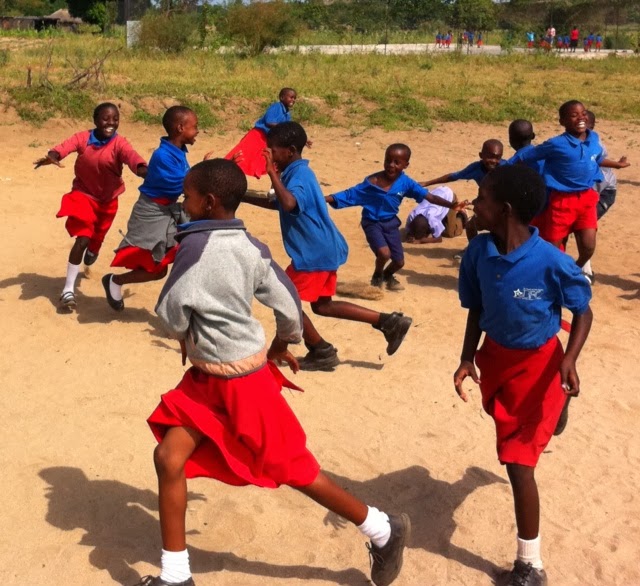
Second grade teacher Mrs. Zaina recently led her class in on the Right to Play games - Spiders. The class started with a stretch and a warm up activity. Mrs. Zaina then led a short discussion about what spiders eat and how that affects the environment around us. The game then started with two spiders in the middle and children on either side having to run by them without being tagged. Those who are tagged then become spiders.

Spider madness ensued....


And a whole of smiles...


After 20 minutes of this massive game of tag,  Mrs. Zaina led another discussion. She asked questions like: "Did you feel safer running from the spiders or being home in the safe zone? Why?"
She then followed up by asking what the children do to be safe at home- the answers included:
- washing our bodies to prevent disease
- washing our clothes
- sleeping with a mosquito net
- playing to be happy
- eating healthy food
- drinking clean water

After the discussion the children participated in a cool down activity by pretending to pick mangos from a tree, out them in a basket, and eat them.

As you can see from the smiles on the kids' faces, this activity was a lot of fun. But it also got the kids thinking about some important life lessons.

We're glad to have partners like Right to Play in our mission to end poverty.


Blogger Seth Diemond is JBFC's Campus Director.

Monday, February 3, 2014

JBFC Difference: School Clubs

 
I recently wrote about the excitement of opening a new school year at JBFC and Joseph and Mary Schools and the promise for the future that comes with that. This excitement is shared across Tanzania, if not the world. However, there is something that we do at JBFC and Joseph and
Mary Schools that sets us apart from education in the rest of Tanzania- school clubs.

In my five years of working with schools, NGO's, and students in Tanzania, I have very rarely come across school clubs that actually meet- extra-curricular activities that are an integral part of our
development into well-rounded, well-educated, capable, leaders in America. These activities are even more important in Tanzania where a strict curriculum and a lack of access to resources, information, and tools stunt interest and make it hard for students to gain the knowledge and skills that are often found outside of an official curriculum.

This year, Chris, Melinda, and I will be partnering with our Tanzanian teachers to pass on their knowledge, interests, and skills to students outside of the traditional classroom setting.

This year's clubs will include:

1st Grade English Competition


-Our pre-school through 3rd grade students will be participating in English games and competitions every Friday to improve their basic understanding of the English language.

-Chris and one of our science teachers, Mr. Cornelly, will be leading a poly-culture club to pass along to our students the skills that our poly-culture experts have taught us. They will be learning techniques in sustainable agriculture, methods to be self-reliant as they become young adults, and the joy that comes with working on a farm to provide your own food.


Budding Young Journalists
 
 
-Melinda will be co-leading a journalism club that will eventually produce a school newspaper and a year book and in the process improve our students' writing skills.


Neema R during Debate Club


-Mr. Freddrick and I will be co-leading a debate and current events club that will pass along our passion and knowledge of world events to our students and train them in speaking in front of groups, sharing ideas, and the importance of valuing different perspectives and viewpoints.


Debate Club trying not to laugh during tongue twisters


Jonas laughing during Drama Club


-A reading club led by our librarian, Mr. Simon, will involve students in reading groups and book clubs to improve their reading and comprehension skills. The ability to read in English and to appreciate the value of books is an integral part of educating the next generation of Tanzanian leaders.


-Other teachers will be leading clubs in arts and crafts, music, and drama.

Something so often taken for granted in America and often under-appreciated is helping us revolutionize and re-define education in Tanzania and in our effort to create well rounded, well-informed, global leaders.


Blogger Seth Diemond is JBFC's Campus Director.